| HISTORY OF SAN FRANCISCO HOSPITAL.
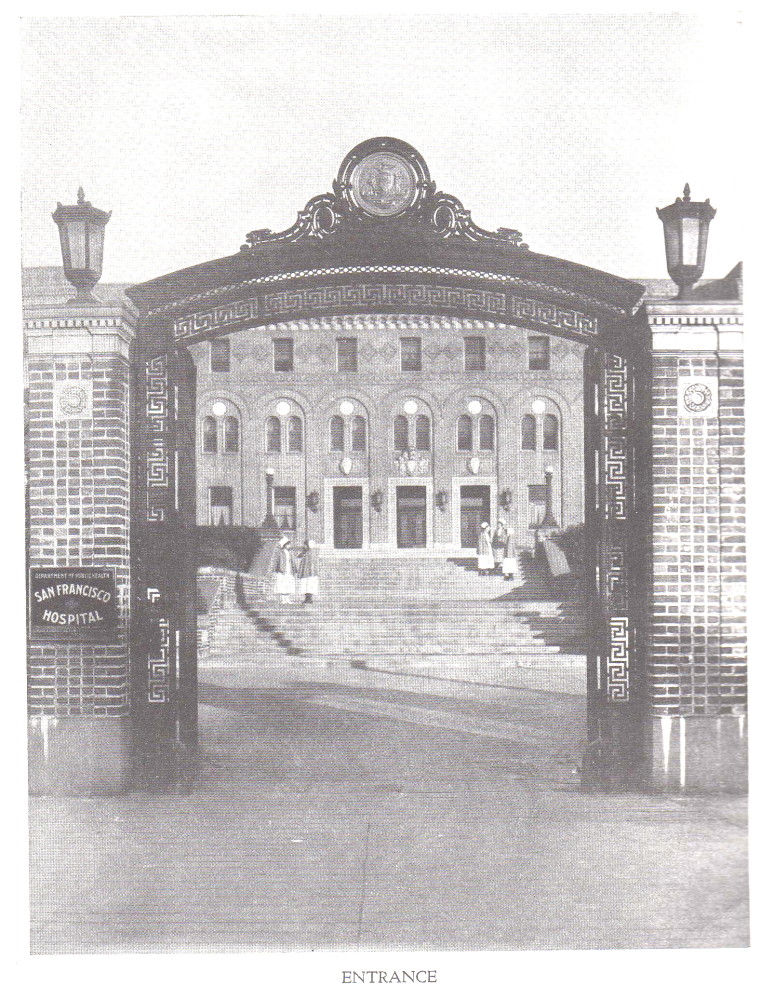
SITUATED on gently sloping ground in the
region of the city known as the warm belt of the Mission, stands the San
Francisco Hospital. The buildings are designed on the ensemble plan, the
Italian Renaissance style of architecture prevailings, with the main walls
in rich colored brick with terra cotta trimmings.
In reviewing the events which culminated in the building of the present
hospital, we find that the original San Francisco Hospital was built in
1872, being a three story wooden structure occupying the site of the present
hospital. As the needs arose, increased additions were made, until an area
of over one square city block was covered. After the great fire of 1906,
the hospital which had been used for the care of the sufferers of the bubonic
plague, was condemned as unsanitary and later was burned. The functioning
unit of the hospital was then accomodated in the newly constructed Relief
Home. The necessity for a new hospital as now urgent so by means of a two
million dollar bond issue, voted for in June, 1906, and with the aid of
subsequent donations, making a total of three and one-half million dollars,
the present location of the hospital was purchased, and construction of
the new edifice was commenced the same year.
The year 1915 witnessed the completion of the hospital as it stands
today. It covers an area of two square city blocks. The main hospital is
constructed in such a manner that each of the four wings of the building
have a direct connection with each other, and with a main administration
office by means of a spacious corridor. Each ward can accommodate thirty-two
patients and is individually equipped with a treatment room, linen room,
diet kitchen with dining room attached, and a large solarium. This main
hospital has a capacity for six hundred patients.
Located at the north end of the hospital is the receiving building which
serves the manifold purpose of receiving patients entering the hospital;
for use as an emergency hospital; for treatment of minor cases. Pre-natal
and post-natal work is also carried on in this department.
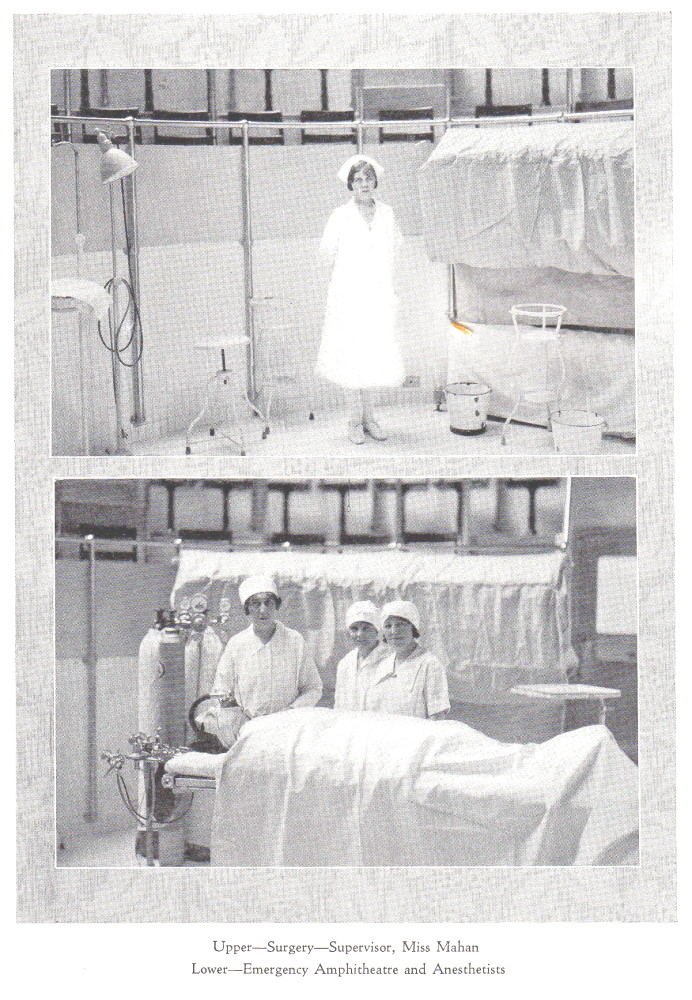
On the second floor of the admission building the surgery is located.
It is accessible to the surgical wards, and also all cases from the five
out-lying emergency hospitals are easily conveyed here.
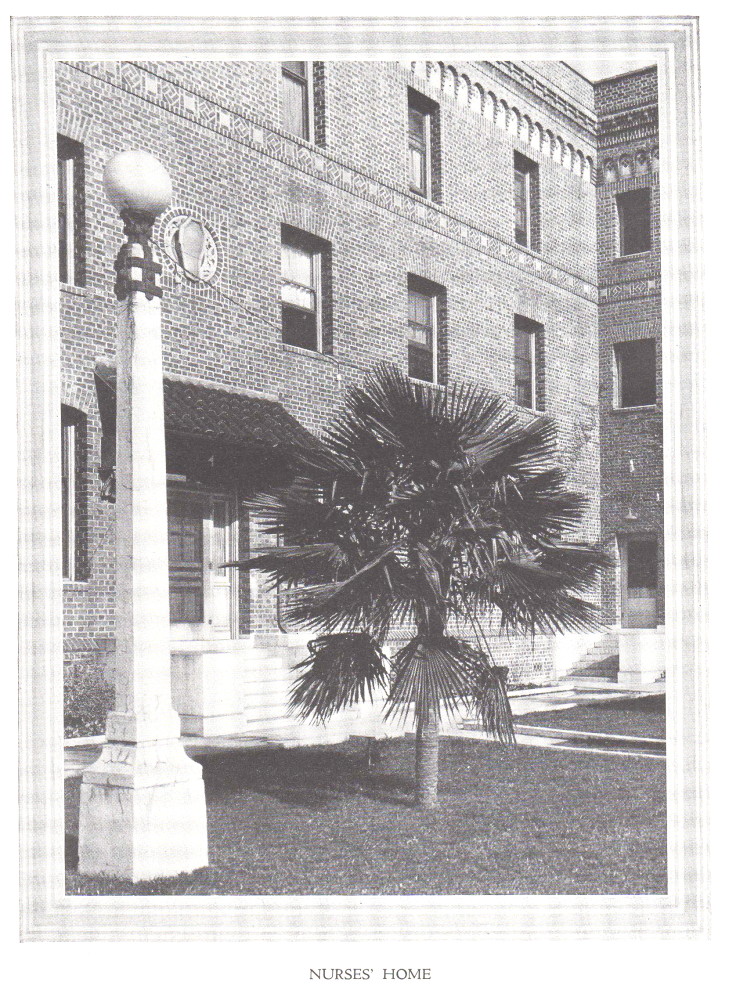
At the south end of the hospital is the Nurses' Home. This home is a
three story brick structure with every modern convenience to make home
life of the student nurses comfortable. The grounds surrounding are attractive
with lawns and gardens. In considering the complementary buildings of the
hospital the tuberculosis department is the largest. It has a capacity
of three hundred and fifty patients. Outdoor sleeping porches form a part
of each ward. During the past year a children's tuberculosis department
has been added where the children have plenty of fresh air and sunlight,
arranged for by means of large sun porches. The grounds about this building
are beautiful with its gardens and lawns.
A special department of instructional therapy is carried on whereby
the patients who are able are kept occupied with pleasing interesting work.
In the Isolation Department, communicable diseases, of every nature,
are treated. This unit functions individually so as to allow no cross infection
to the other part of the hospital. Students training here have unusual
opportunities for clinical study and through the ambulance service, to
study home conditions, as well as the hospital aspect.
oOo |