
Early Post Office
Early Post Office
 THE
HISTORY OF A LETTER.
THE
HISTORY OF A LETTER.
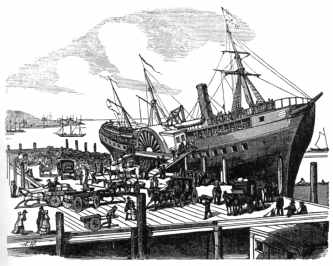
Language is incapable of expressing the thrill of feeling which passes through the mind, when, from the outer telegraph station at Point Lobos, a telegram announces in San Francisco that "the mail steamer—is in sight,—miles outside the heads." To almost all "expectation is on tip-toe," and the welcome intelligence is rapidly passed from lip to lip, and recorded on the various bulletin boards of the city, that the "—steamer is telegraphed." After an hour or more of suspense, the loud boom-oom-oom-o-o-o-o-o-m of the steamer's gun reverberates through the city, and announces that she is passing between Alcatraz Island and Telegraph Hill, and will soon be at her berth alongside the wharf.
Almost simultaneously with the sound of the steamer's gun, the newsboys are shouting the "arrival of the steamer," and the "New York Herald," "New York Tribune," "Fourteen days later news from the Eastern States." Meanwhile, all the news depots are crowded with eager applicants for the latest news; and, in order to obtain it as early as possible, small boats have been in waiting off Meiggs' Wharf, to receive the bundles of "express" newspapers thrown them from the steamer as she passed, and the moment these boats reach the dock, fast horses, which have also been kept in waiting, speedily carry the bundles to the city.
Carriages and other vehicles now begin to rumble and clatter through the streets, in the direction of the steamer's wharf; men commence walking towards the post office, or gather in groups upon the sidewalks, to learn or discuss the latest news. Interest and excitement seem to become general.
On the dock, awaiting the delivery of the mail-bags, mail wagons and drays are standing; and as fast as the mail matter is taken from the vessel, it is removed to the post office.
 While
the loaded wagons and drays, with mail matter, are hastening to the general
delivery, and the passengers who have just arrived are seeking the various
hotels, in carriages or on foot, after hiring a porter to carry their baggage,
or becoming their own for the time being; let us, while all this is going
on, make our way to the post office, there to see what we can.
While
the loaded wagons and drays, with mail matter, are hastening to the general
delivery, and the passengers who have just arrived are seeking the various
hotels, in carriages or on foot, after hiring a porter to carry their baggage,
or becoming their own for the time being; let us, while all this is going
on, make our way to the post office, there to see what we can.
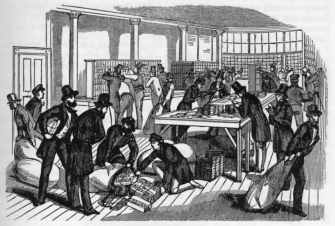
Men we find are hurrying to and fro, and gathering in front of their letterboxes; some, with the doors open, are waiting to see when the first letter finds its way there, that they may not lose one moment before the contents are enjoyed.
At the various windows—alphabetically arranged, with about as many letters to each window as, in all probability will make the number of applicants at each about equal—men are congregating in single file, forming long and crooked lines, and patiently awaiting the time when the little window will be opened, from which the treasured letter from some dear and absent one is expected. Who can tell the hope and fear, the joy and sorrow, the love and (perhaps) hate, the good and evil, that occupy the minds of those who thus stand watching and waiting for the little missives.
 Further
on, too, at the end of the building, and apart from the rest, is the ladies'
window; and here stand a row of ladies and gentlemen, waiting as patiently
as at the others. The gentlemen, who form part of the line, do so to obtain
letters for their wife, or sister, or perhaps sweetheart, or other lady
friend; and, if they are there first, they invariably give precedence to
the ladies, no matter how many may come, or how long they may be thus detained.
Further
on, too, at the end of the building, and apart from the rest, is the ladies'
window; and here stand a row of ladies and gentlemen, waiting as patiently
as at the others. The gentlemen, who form part of the line, do so to obtain
letters for their wife, or sister, or perhaps sweetheart, or other lady
friend; and, if they are there first, they invariably give precedence to
the ladies, no matter how many may come, or how long they may be thus detained.
At the centre of the building, mail-bags are being carried in from the mail wagons and drays, one after the other, to the number of from two to three hundred and upwards; we wonder how, out of that mass of apparent confusion, order will be restored; or how, in the course of a few hours, thirty-five thousand letters and newspapers will be properly arranged for distribution to the various boxes and delivery windows. Have patience, and we shall see.
Before entering the post office with the reader, we wish most sincerely to express our thanks to Mr. Charles L. Weller, the Postmaster, Mr. John Ferguson, his assistant, and the other gentlemen belonging to this department, for the courtesy and promptness with which they placed the various and interesting particulars concerning this important branch of the public service, at our command. While the mail-bags are being examined, to ascertain their contents, whether letters or papers, for San Francisco or the interior cities, let us read over the rules of the office, for our especial entertainment:
RULES AND REGULATIONS.
I.—General office hours from 8 A. M. to 5 P. M., Sunday excepted, on
which day the office will be kept open from 9 to 10 A. M.
II.—The mailing clerks will be at their posts at 6 A. M., the box clerk
at 6½ A. M., and all other clerks and employés at 7½
A. M.
III.—No clerk will absent himself from the office during office hours,
without the knowledge and consent of the Postmaster, or, in his absence,
the Assistant Postmaster.
IV.—Courtesy and forbearance, and a spirit of accommodation, being
requisite to efficient services, they should be extended to everybody with
whom clerks may have business intercourse.
V.—Memory must not be trusted to, but when an applicant presents himself
for a letter or paper, thorough search must be made in the appropriate
place, and care will be taken to let the applicant see the search made.
VI.—When an applicant shall Exhibit a disposition to aggravate, or
insult, or even abuse, he should be met with forbearance and gentlemanly
conduct, recollecting that the contact is of a business nature only, and
that personalities should be adjourned to outside the office entirely.
If a clerk fails to satisfy an applicant, let him be referred to the Postmaster,
VII.—Angry or excited discussions upon any subject must not be indulged
in during office hours.
VIII.—Clerks will not carry from the office, letters for their outside
friends and acquaintances, nor receive letters from such out of the office
for mailing.
IX.—Each clerk will confine his delivery of letters to his own alcove,
except when he may be acting as a relief for the time being.
X.—None other than delivery clerks will disarrange, handle, or deliver
letters, at any alcove, at any time.
XI.—If application be made for letters inside the office, when deliveries
are not open, the applicant will in all cases be referred to the Postmaster
or his assistant.
XII.—No person except sworn clerks and employés must be permitted
to handle mail matter, or come within reach thereof.
XIII.—During any absence of the Postmaster, his whole authority over
the the internal affairs of the office rests with his assistant, and that
officer will be respected accordingly.
Now the scene around us is becoming interesting. The bustle and exciting life that first presented itself on the outside, by the arrival of the mail-bags, seems to have extended within; for on all sides great activity—systematic activity—is the order of the time. It appears that the Postmaster, on the arrival of each steamer, engages a corps of from fifteen to twenty-five extra assistant clerks, in order to facilitate more rapidly the distribution of the mail; aud these, with the regular force, are all busy in the departments assigned them.
While all this is going on in one department, the mail-bags containing packages of newspapers for the different newspaper firms in the city, are being opened, checked, and removed, in another. Every part of the office is literally alive with active business; slow coaches would be at an immense discount here at all times, especially when the mail has just arrived, and when it is about to depart.
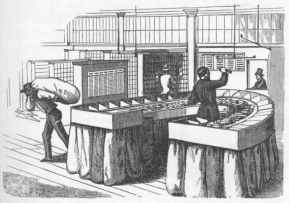
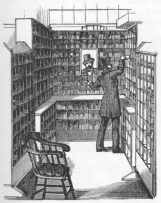
The bags containing the letter mail for distribution in San Francisco, are rapidly selected from the others, and passed to the "examining table," where they are opened, and the contents compared with the "post bill" which accompanies them; after which they are deposited in "alphabetical cases" in the following manner: A letter, for instance, addressed "John Adams," is placed under the division A; those addressed "Timothy Brown," under division B; and so forth, to the end of the alphabet. From thence they are taken to the different alcoves, to which they belong alphabetically, and where each delivery clerk has cards placed, upon which is written the name of every box-holder, commencing with letters belonging to his alcove, with the number of the box; and, as each letter is examined, it is marked with the box number to which it belongs; it is then sent out to be placed in a case, and distributed according to number, thus: Letters from 1 to 100 are placed in one division; from 100 to 200 in another; and so on, to the highest corresponding number of the box; and from this case they are taken by clerks to the boxes of the parties to whom they are addressed. If it is not a box letter, it is put up in its proper place in the alcove for general delivery, which is generally opened immediately the whole of the letters are assorted and arranged.
 This
being a distributing post office, and the only one on the Pacific coast,
a great amount of mail matter is sent here for distribution to other points.
Newspapers for the interior, and for Oregon and Washington Territories,
are taken to the newspaper distributing table, rapidly to be distributed
in accordance with their address. Bags of newspaper matter are made up
for Sacramento, Marysville, Benicia, Shasta, Stockton, Columbia, Martinez,
Petaluma, and other places; and all newspapers addressed to points in these
respective districts, are placed in those bags.
This
being a distributing post office, and the only one on the Pacific coast,
a great amount of mail matter is sent here for distribution to other points.
Newspapers for the interior, and for Oregon and Washington Territories,
are taken to the newspaper distributing table, rapidly to be distributed
in accordance with their address. Bags of newspaper matter are made up
for Sacramento, Marysville, Benicia, Shasta, Stockton, Columbia, Martinez,
Petaluma, and other places; and all newspapers addressed to points in these
respective districts, are placed in those bags.
At the same time, another division of the forces is engaged in assorting the letters addressed to offices on this coast other than San Francisco. To facilitate this, a letter-case, with apartments for all the offices in this State and Oregon and Washington Territories, respectively labelled, is used, in which are placed all letters for those points, and mailed as usual.
The following Table will give the name, day of arrival, and number of days out from New York to San Francisco, of each Steamer, from August 31st, 1854, to December 16th, 1857; also, the number of bags of mail matter brought to the San Francisco Post Office:
| Name of Steamer. | Date of Arrival. | Time
From N.Y. |
Number
of Mail Bags. |
Name of Steamer. | Date of Arrival. | Time
From N.Y. |
Number
of Mail Bags. |
|
| Sonora | Aug. 21, 1854 | 26 | 315 | Golden Gate | April 13, 1856 | 24 | 339 | |
| California | Sep. 19, 1854 | 29 | 323 | J. L. Stephens | May 1, 1856 | 27 | 348 | |
| J. L. Stephens | Oct. 2, 1854 | 27 | 293 | Golden Age | May 22, 1856 | 31 | 329 | |
| Golden Age | Oct. 16, 1854 | 26 | 303 | Sonora | June 1, 1856 | 26 | 298 | |
| Sonora | Nov. 1, 1854 | 27 | 291 | Golden Gate | June 15, 1856 | 25 | 354 | |
| Golden Gate | Nov. 13, 1854 | 24 | 292 | J. L. Stephens | July 1, 1856 | 26 | 336 | |
| J. L. Stephens | Dec. 1, 1854 | 25 | 317 | Golden Age | July 14, 1856 | 25 | 331 | |
| Golden Age | Dec. 14, 1854 | 24 | 296 | Sonora | July 29, 1856 | 24 | 318 | |
| Sonora | Dec. 30, 1854 | 25 | 268 | J. L. Stephens | Aug. 14, 1856 | 24 | 313 | |
| J. L. Stephens | Jan. 13, 1855 | 24 | 249 | Golden Age | Aug. 28, 1856 | 23 | 337 | |
| Golden Age | Jan. 29, 1855 | 24 | 277 | Sonora | Sep. 16, 1856 | 27 | 359 | |
| Golden Gate | Feb. 17, 1855 | 28 | 317 | J. L. Stephens | Sep. 29, 1856 | 24 | 309 | |
| Sonora | Mar. 2, 1855 | 25 | 286 | Golden Age | Oct. 14, 1856 | 24 | 299 | |
| J. L. Stephens | Mar. 17, 1855 | 25 | 266 | Sonora | Nov. 1, 1856 | 26 | 296 | |
| Golden Age | Mar. 28, 1855 | 23 | 295 | Golden Gate | Nov. 14, 1856 | 24 | 277 | |
| Golden Gate | April 12, 1855 | 23 | 317 | Golden Age | Dec. 1, 1856 | 26 | 321 | |
| Sonora | May 1, 1855 | 26 | 333 | Sonora | Dec. 16, 1856 | 26 | 302 | |
| J. L. Stephens | May 16, 1855 | 26 | 300 | J. L. Stephens | Dec. 30, 1856 | 25 | 290 | |
| Golden Gate | May 30, 1855 | 25 | 274 | Golden Gate | Jan. 15, 1857 | 26 | 307 | |
| Sonora | June 16, 1855 | 26 | 306 | Sonora | Jan. 30, 1857 | 25 | 286 | |
| Golden Age | June 30, 1855 | 25 | 242 | J. L. Stephens | Feb. 14, 1857 | 25 | 267 | |
| J. L. Stephens | July 13, 1855 | 23 | 268 | Golden Gate | March 2, 1857 | 25 | 342 | |
| Golden Gate | July 28, 1855 | 23 | 303 | Sonora | March 17, 1857 | 25 | 295 | |
| Sonora | Aug. 18, 1855 | 29 | 326 | J. L. Stephens | March 29, 1857 | 24 | 282 | |
| J. L. Stephens | Sep. 1, 1855 | 26 | 294 | Golden Age | April 12, 1857 | 23 | 327 | |
| Golden Age | Sep. 12, 1855 | 23 | 314 | Golden Gate | April 29, 1857 | 23 | 357 | |
| Panama | Oct. 2, 1855 | 26 | 257 | J. L. Stephens | May 15, 1857 | 25 | 310 | |
| Golden Gate | Oct. 16, 1855 | 26 | 234 | Golden Age | May 29, 1857 | 24 | 318 | |
| Sonora | Oct. 29, 1855 | 24 | 279 | Golden Gate | June 15, 1857 | 26 | 316 | |
| J. L. Stephens | Nov. 14, 1855 | 25 | 323 | Sonora | June 30, 1857 | 25 | 319 | |
| Golden Age | Nov. 29, 1855 | 24 | 291 | J. L. Stephens | July 15, 1857 | 25 | 295 | |
| Sonora | Dec. 15, 1855 | 25 | 316 | Golden Age | July 31, 1857 | 25 | 294 | |
| J. L. Stephens | Jan. 1, 1856 | 27 | 322 | Sonora | Aug. 14, 1857 | 25 | 295 | |
| Oregon | Jan. 12, 1856 | * | 37 | J. L. Stephens | Aug. 30, 1857 | 25 | 295 | |
| Golden Age | Jan. 15, 1856 | 26 | 289 | Golden Age | Sep. 14, 1857 | 25 | 306 | |
| Sonora | Jan. 30, 1856 | 25 | 274 | Sonora | Oct. 1, 1857 | 26 | 318 | |
| Golden Gate | Feb. 14, 1856 | 24 | 301 | Panama | Oct. 22, 1857 | 31 | 294 | |
| J. L. Stephens | March 1, 1856 | 24 | 295 | J. L. Stephens | Nov. 2, 1857 | 26 | 290 | |
| Golden Age | March 14, 1856 | 23 | 278 | Golden Age | Nov. 17, 1857 | 28 | 315 | |
| Sonora | March 28, 1856 | 23 | 322 | Sonora | Nov. 30, 1857 | 25 | 276 | |
| Oregon | April 12, 1856 | * | 22 | Golden Gate | Dec. 16, 1857 | 26 | 344 | |
| * Only from Panama. |
 Now,
hoping that the reader has received very interesting correspondence from
his friends, and digested the contents, let us see what is done with those
large piles of bags that are as yet unopened. Some we see are marked "Sacramento
Dis.," others "Stockton Dis.," others Marysville, Placerville, Nevada,
Sonora, or some other "Dis." in the interior; and are placed upon the mail
wagons, conveyed to the steamboats plying nearest to those places, and
sent away as speedily as it is possible for them to be. No unnecessary
delay is allowed to detain them, nor are they in the general bustle, by
any means lost sight of. One would suppose that Argus, with his hundred
eyes, would find opportunity fully to employ them all, were he postmaster
at such a time as this. Every part is worked by system which experience
has so far perfected; and this is the secret why so much is accomplished
in so short a time. Those who ever feel desirous of complaining of delay,
might do well to remember how matters went some four or six years ago.
Now,
hoping that the reader has received very interesting correspondence from
his friends, and digested the contents, let us see what is done with those
large piles of bags that are as yet unopened. Some we see are marked "Sacramento
Dis.," others "Stockton Dis.," others Marysville, Placerville, Nevada,
Sonora, or some other "Dis." in the interior; and are placed upon the mail
wagons, conveyed to the steamboats plying nearest to those places, and
sent away as speedily as it is possible for them to be. No unnecessary
delay is allowed to detain them, nor are they in the general bustle, by
any means lost sight of. One would suppose that Argus, with his hundred
eyes, would find opportunity fully to employ them all, were he postmaster
at such a time as this. Every part is worked by system which experience
has so far perfected; and this is the secret why so much is accomplished
in so short a time. Those who ever feel desirous of complaining of delay,
might do well to remember how matters went some four or six years ago.
Supposing that the mail which has arrived is all distributed, we should like the reader's company to see how the letter and newspaper mails are made up for Eastern conveyance and distribution.
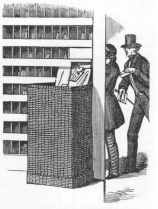 Of
course we take it for granted that you have written your letter; and which,
being prepaid in stamps if it is for any portion of our Union, and in money
if for foreign distribution, has found its way into the "drop basket" within
the office. From this they are first taken to the "facing up table," that
they may all be "faced" with the address before you: they are then conveyed
to the "sorting case," for the purpose of weighing and ascertaining that
the full amount of postage due on each letter is paid: after this is satisfactorily
settled, they are passed to the "stamping-block," that the office-stamp,
with the date of mailing, may be imprinted upon them: they are then placed
in the "distributing case," that they may receive proper distribution according
to their address. The letters are now ready to be entered upon the "post-bill"—similar
to the one received with the lettermail on the arrival of the steamer at
this port—which is done in this wise: say, for instance, the mail is now
made up for "New York Distribution," which includes all letters addressed
to the following places: New York State, Rhode Island, Connecticut, eastern
and northern counties of New Jersey, northern counties of Pennsylvania
and Ohio, Michigan, and Lower Canada. Letters thus addressed are laid upon
the "mailing table," when all letters of the same rate of postage are placed
together, and their number and rate of postage is entered on the "post-bill."
After this is done, they are put up in convenient-sized packages (generally
about eighty letters in one package) and stamped "New York Dis." They are
then put in a mail-bag labeled "N. Y. Dis.," and are then ready to be dispatched
over their route of destination. The same process is adopted in the making
up of all the mails to every portion of the Union; and all this is done
with the view of securing dispatch, and avoiding unnecessary labor and
consequent delay.
Of
course we take it for granted that you have written your letter; and which,
being prepaid in stamps if it is for any portion of our Union, and in money
if for foreign distribution, has found its way into the "drop basket" within
the office. From this they are first taken to the "facing up table," that
they may all be "faced" with the address before you: they are then conveyed
to the "sorting case," for the purpose of weighing and ascertaining that
the full amount of postage due on each letter is paid: after this is satisfactorily
settled, they are passed to the "stamping-block," that the office-stamp,
with the date of mailing, may be imprinted upon them: they are then placed
in the "distributing case," that they may receive proper distribution according
to their address. The letters are now ready to be entered upon the "post-bill"—similar
to the one received with the lettermail on the arrival of the steamer at
this port—which is done in this wise: say, for instance, the mail is now
made up for "New York Distribution," which includes all letters addressed
to the following places: New York State, Rhode Island, Connecticut, eastern
and northern counties of New Jersey, northern counties of Pennsylvania
and Ohio, Michigan, and Lower Canada. Letters thus addressed are laid upon
the "mailing table," when all letters of the same rate of postage are placed
together, and their number and rate of postage is entered on the "post-bill."
After this is done, they are put up in convenient-sized packages (generally
about eighty letters in one package) and stamped "New York Dis." They are
then put in a mail-bag labeled "N. Y. Dis.," and are then ready to be dispatched
over their route of destination. The same process is adopted in the making
up of all the mails to every portion of the Union; and all this is done
with the view of securing dispatch, and avoiding unnecessary labor and
consequent delay.
Register of Departure of the Mails for the Atlantic States, via Panama, &c.; names of the Steamers, date of sailing, and number of bags of mail matter:
| Name of Steamer. | Date of Departure. | No. Bags
Matter. |
Name of Steamer. | Date of Departure. | No. Bags
Matter |
|
| John L. Stephens | Sep. 1, 1854 | 108 | John L. Stephens | May 21, 1856 | 129 | |
| Panama | Sep. 16, 1854 | 89 | Golden Age | June 5, 1856 | 149 | |
| Sonora | Sep. 30, 1854 | 101 | Sonora | June 20, 1856 | 150 | |
| Golden Gate | Oct. 16, 1854 | 116 | John L. Stephens | July 5, 1856 | 142 | |
| John L. Stephens | Nov. 1, 1854 | 100 | Golden Age | July 21, 1856 | 147 | |
| Golden Age | Nov. 16, 1854 | 114 | Sonora | Aug. 5, 1856 | 121 | |
| Sonora | Dec. 1, 1854 | 91 | John L. Stephens | Aug. 20, 1856 | 141 | |
| John L. Stephens | Dec. 16, 1854 | 93 | Golden Age | Sep. 5, 1856 | 140 | |
| Golden Age | Jan. 1, 1855 | 107 | Sonora | Sep. 20, 1856 | 114 | |
| Sonora | Jan. 16, 1855 | 98 | Golden Gate | Oct. 6, 1856 | 129 | |
| John L. Stephens | Feb. 1, 1855 | 108 | Golden Age | Oct. 20, 1856 | 113 | |
| Golden Age | Feb. 16, 1855 | 99 | Sonora | Nov. 5, 1856 | 115 | |
| Golden Gate | March 1, 1855 | 102 | John L. Stephens | Nov. 20, 1856 | 122 | |
| Sonora | March 16, 1855 | 85 | Golden Gate | Dec. 5, 1856 | 99 | |
| John L. Stephens | March 31, 1855 | 95 | Sonora | Dec. 20, 1856 | 112 | |
| Golden Age | April 17, 1855 | 103 | John L. Stephens | Jan. 5, 1857 | 120 | |
| Golden Gate | May 1, 1855 | 89 | Golden Gate | Jan. 20, 1857 | 96 | |
| Sonora | May 16, 1855 | 80 | Sonora | Feb. 5, 1857 | 121 | |
| John L. Stephens | June 1, 1855 | 100 | John L. Stephens | Feb. 20, 1857 | 119 | |
| Golden Gate | June 16, 1855 | 102 | Golden Age | March 5, 1857 | 103 | |
| Sonora | June 30, 1855 | 92 | Golden Gate | March 20, 1857 | 119 | |
| John L. Stephens | July 16, 1855 | 97 | Golden Gate | March 23, 1857 | 6 | |
| Golden Age | Aug. 1, 1855 | 95 | John L. Stephens | April 6, 1857 | 115 | |
| Golden Gate | Aug. 18, 1855 | 94 | Golden Age | April 20, 1857 | 102 | |
| Oregon | Sep. 5, 1855 | 93 | Golden Gate | May 5, 1857 | 122 | |
| Sonora | Sep. 20, 1855 | 96 | John L. Stephens | June 1, 1857 | 116 | |
| John L. Stephens | Oct. 5, 1855 | 82 | Sonora | May 20, 1857 | 104 | |
| Golden Age | Oct. 20, 1855 | 95 | Golden Age | June 20, 1857 | 96 | |
| Sonora | Nov. 5, 1855 | 93 | Sonora | July 4, 1857 | 109 | |
| John L. Stephens | Nov. 20, 1855 | 96 | John L. Stephens | July 20, 1857 | 108 | |
| Golden Age | Dec. 5, 1855 | 101 | Golden Age | Aug. 5, 1857 | 121 | |
| Sonora | Dec. 20, 1855 | 113 | Sonora | Aug. 20, 1857 | 102 | |
| Golden Gate | Jan. 5, 1856 | 89 | California | Sep. 5, 1857 | 112 | |
| John L. Stephens | Jan. 21, 1856 | 125 | John L. Stephens | Sep. 21, 1857 | 109 | |
| Golden Age | Feb. 5, 1856 | 101 | Golden Gate | Oct. 5, 1857 | 91 | |
| Sonora | Feb. 20, 1856 | 106 | Golden Age | Oct. 11, 1857 | 23 | |
| Golden Gate | March 5, 1856 | 95 | Sonora | Oct. 20, 1857 | 96 | |
| John L. Stephens | March 20, 1856 | 107 | Golden Gate | Nov. 5, 1857 | 125 | |
| Golden Age | April 5, 1856 | 126 | John L. Stephens | Nov. 20, 1857 | 110 | |
| Sonora | April 21, 1856 | 116 | Golden Age | Dec. 5, 1857 | 110 | |
| Golden Gate | May 5, 1856 | 92 | Golden Gate | Dec. 21, 1857 | 94 |
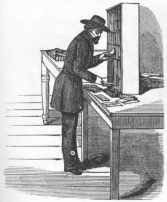 RATES
OF FOREIGN POSTAGE ON LETTERS.
RATES
OF FOREIGN POSTAGE ON LETTERS.
(PER ½ OUNCE.)
South Pacific.—Eucador, Bolivia, and Chili, 34 cents; Peru, 22; Panama,
20 cents; and Mexico, 10 cents. Spain, 78 cents; West Indies (not British),
Cuba excepted, 44 cents; Cuba, 20 cents; West Indies (British), 20 cents.
Payment required for all the above.
Great Britain, 29 cents; Canada and Provinces, 15 cents; France, 15 cents per quarter oz.; Germany, 30 cents; Russia, 37 cents; Norway, 46 cents; Sweden, 42 cents; Italy, 33 cents; Switzerland, 35 cents; Holland, 26 cents; Austria 30 cents; and Prussia, 30 cents. For the above, prepayment is optional.
All ship letters, prepaid, are one cent.
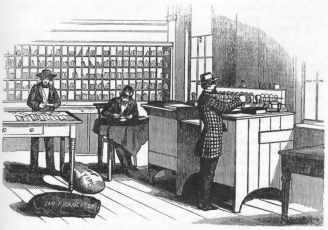 The
number of stamps and envelops sold monthly at the San Francisco Post Office
will about average—of one cent stamps, 45,000; three cents, 27,000; ten
cents, 32,000; twelve cents, 500. Of stamped envelops, three cents, 120,000,
(of which Wells, Fargo & Co. use nearly 100,000 per month); six cents,
500; ten cents, 12,000. This statement, it should be remembered, is principally
for the city of San Francisco alone; inasmuch as the principal interior
offices obtain their supplies of stamps and envelops direct from the General
Post Office, Washington.
The
number of stamps and envelops sold monthly at the San Francisco Post Office
will about average—of one cent stamps, 45,000; three cents, 27,000; ten
cents, 32,000; twelve cents, 500. Of stamped envelops, three cents, 120,000,
(of which Wells, Fargo & Co. use nearly 100,000 per month); six cents,
500; ten cents, 12,000. This statement, it should be remembered, is principally
for the city of San Francisco alone; inasmuch as the principal interior
offices obtain their supplies of stamps and envelops direct from the General
Post Office, Washington.
The U. S. postage on letters for each half ounce is, if under three thousand miles, three cents; over three thousand miles, ten cents. For newspapers the postage is one cent to any part of the U.S. Magazines not exceeding one and a half ounces one half cent; not exceeding three ounces, one cent; over three ounces, one and a half cent.
On newspapers sent to foreign places, the following are the rates of postage: To the West Indies, 6 cents; South Pacific Coast, 6; German States, Denmark, Holland, Prussia, Russia, Sweden, Norway, Switzerland, and Italy, 6 cents; Great Britain and France, 2 cents; British North American Provinces, 1 cent.
SCHEDULE OF MAIL DEPARTURES PROM SAN FRANCISCO POST OFFICE.
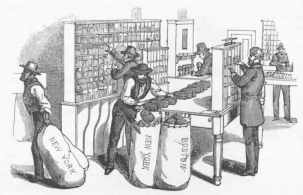 Atlantic
States, via Panama, 5th and 20th of every month.
Atlantic
States, via Panama, 5th and 20th of every month.
San Diego and Salt Lake, 3d and 18th of every month.
Oregon and Washington Territories, taking mails also for the Northern
Coast, 1st and 21st of every month.
San Jose, 8 A. M. every day.
Northern Mail via Sacramento, 4 P. M. every day, Sundays excepted.
Southern and Eastern Mail via Stockton, 4 P. M. every day, Sundays
excepted.
Mails are kept open until ten minutes before the hour of departure, except for the Atlantic, in which case thirty minutes for closing the mails; though it would be better for the convenience of the Post Office, as well as for the safety of the correspondence, if letters were mailed during the night previous.
Ship Mails are despatched by every opportunity for the Sandwich Islands, Society Islands, Australia, and China. Postage on letters to all parts of the Pacific, by ship, to be prepaid.
DEAD LETTERS.—Letters technically termed "dead," are such as have been advertised, and have remained on hand three months; including letters refused; letters for foreign countries which cannot be forwarded without pre-payment of postage; letters not addressed, or so badly directed that their destinations cannot be ascertained; and letters addressed to places which are not Post Offices. All the dead letters are returned to San Francisco at the middle or end of each Post Office quarter, which is on the last day of March, June, September, and December. Refused and dropped letters are not advertised. Every dead letter, before its return to San Francisco, is stamped or postmarked on the sealed side, with the name of the office and the date of its return.
