Care Free San Francisco
By Allan Dunn
Care Free San Francisco
By Allan Dunn
 Before
the fire, when cable cars clattered up Market Street, that thoroughfare
divided the city into two parts, and one was born and raised "north" or
"south of the slot," and thus classes as artistocrat or plebian. The "slot
southron" was of the horny-handed, tougher type of humanity; his district
was of the Bowery order. To the north the homes of the classes with more
money and more leisure fringed the down-town commercial district and climbed
Nob Hill, while the higher they climbed the more they literally "looked
down" upon those of the lower levels. The entire waterfront, as ever in
a seaport town, had its fringe of the humanity that go down to the sea
in ships. Telegraph Hill was then, as now, the Latin Quarter, close neighbor
to Chinatown, and both fringing Russian Hill, still the Art Colony—a Bohemia
of all orders, from the artistic to the rough-and-ready. This portion is
unchanged, but Market Street, though the main artery of the city, is no
more the dividing line.
Before
the fire, when cable cars clattered up Market Street, that thoroughfare
divided the city into two parts, and one was born and raised "north" or
"south of the slot," and thus classes as artistocrat or plebian. The "slot
southron" was of the horny-handed, tougher type of humanity; his district
was of the Bowery order. To the north the homes of the classes with more
money and more leisure fringed the down-town commercial district and climbed
Nob Hill, while the higher they climbed the more they literally "looked
down" upon those of the lower levels. The entire waterfront, as ever in
a seaport town, had its fringe of the humanity that go down to the sea
in ships. Telegraph Hill was then, as now, the Latin Quarter, close neighbor
to Chinatown, and both fringing Russian Hill, still the Art Colony—a Bohemia
of all orders, from the artistic to the rough-and-ready. This portion is
unchanged, but Market Street, though the main artery of the city, is no
more the dividing line.
South of it now are manufactories, the railroad yards, cheap hotels and a melange of Greek and Servian restaurants, boarding-houses and amusement places. Its original population has drifted south into the district of the Mission and down the peninsula, into a healthier form of living, rearing a sturdier generation.
The so-called poorer classes live under happier conditions here. You can't submerge a "tenth" in an out-doors land, and foraging is easy in a climate where ice in summer and coal in winter are really luxuries, never necessities. There is no anemia and little indigence. The gum-selling, match-vending urchins of the Rooseveltian families of the Latin Quarter are full-cheeked, round of limb, with stomachs well lined with spaghetti. Even sleeping out in a barrel or a box loses its terrors where King Frost owns no realty. Blue noses, shivering limbs and chilblains leave the most unfortunate alone. The streets are an everyday playground, and there are parks everywhere, from Golden Gate, with its fifteen hundred verdant flower-set acres to Portsmouth Square, set between Chinatown, the Italian Quarter and the darker places of the city.
Nob Hill, with its homes of the wealthy, remains, though many of the owners have supplementary country places in the southern suburbs. There is a gap, partly filled by apartment houses, where the dwelling houses once joined the down-town business district, but far out to the west, across the breadth of the city, stretches the residence district, and southward, past the Mission by aristocratic Burlingame, Menlo Park and Redwood City, bungalows humble and elaborate alternate with palatial country estates.
 Take
your right hand. The extended thumb well represents the peninsula at the
head of which, on the nail, stands San Francisco, with its growing population,
ever squeezed out downwards, past the knuckle. Between thumb and fingers
is the southern arm of the great bay. To the north the other half of this
island sea balances it with, at its upper end, the combined streams of
the navigable Sacramento and San Joaquin rivers, ever combatting the saltiness
of the waters. The western shore of this northern arm curves down to make
the northern portal of the Golden Gate. The city occupies the whole nail.
In early days it was easily divided into the Presidion and Potrero with
the Devisadero (now Divisadero Street) between; the Mission and the Embarcadero,
good old romantic and yet practical names. Today, the inside of the nail
forms the main waterfront, which swings north along the rim, but mainly
faces east and the mainland.
Take
your right hand. The extended thumb well represents the peninsula at the
head of which, on the nail, stands San Francisco, with its growing population,
ever squeezed out downwards, past the knuckle. Between thumb and fingers
is the southern arm of the great bay. To the north the other half of this
island sea balances it with, at its upper end, the combined streams of
the navigable Sacramento and San Joaquin rivers, ever combatting the saltiness
of the waters. The western shore of this northern arm curves down to make
the northern portal of the Golden Gate. The city occupies the whole nail.
In early days it was easily divided into the Presidion and Potrero with
the Devisadero (now Divisadero Street) between; the Mission and the Embarcadero,
good old romantic and yet practical names. Today, the inside of the nail
forms the main waterfront, which swings north along the rim, but mainly
faces east and the mainland.
Opposite, at the second knuckle of the first finger, lie the transbay cities of Oakland, Berkeley and islanded Alameda, at the foot of the Berkeley hills. By the outer corner of the nail rim is the Presidio as of yore, and the Ocean Boulevard following the outer curve. Straight across the city, east and west, runs Market Street. Twin Peaks at its end are to be burrowed through, the Panhandle of the great Golden Gate Park juts from the main grounds and ties up the Pacific Ocean with the city and the inner sheltered bay.
To feel the pulse of a city and to test its temperature, watch its streets.There are scenes of San Francisco highways so distinctive, so unique, that the memories of them never fade.
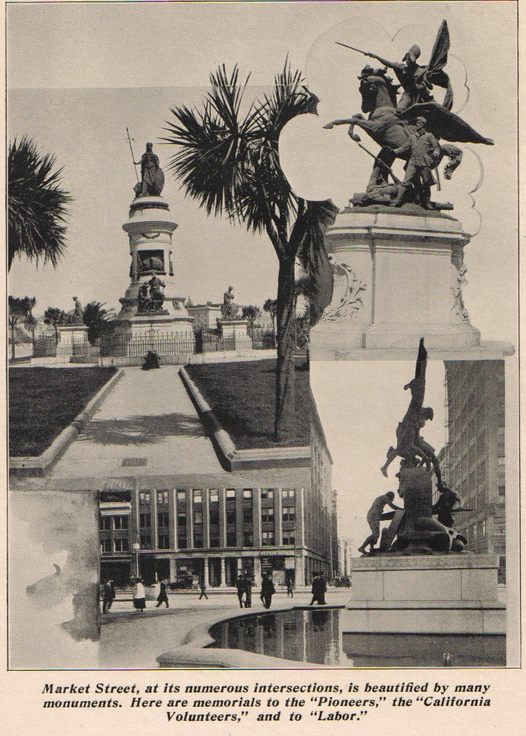
Let us take Market Street, partly commercial thoroughfare, shopping district, amusement center and boulevard. With its broad sidewalks, running to sunrise and sunset, backed by high cliffs of stone and "reinforced concrete," it has two climates, two temperatures of sun and shade. They say you can wear flannels on one side and furs on the other, which is not uncomfortably true, though people really only wear furs as they follow the season's fashions in San Francisco—for exhibition purposes, to encourage the shopkeepers and for visiting purposes to climes less favored than this,
For we only know it's Christmas by the calendar out here.
Before noon Market Street is a bustle of business men. At noon the bright-eyed blooming youth of the office forces debouche for luncheon and a "how-d'ye-do." Then come the down-town cars to discharge shopping matrons, and forth come the butterflies of leisure and of pleasure. Towards the half light the working bees buzz out again and turn drones for the hour before dinner (the five-o'clock promenade.) Playtime has commenced. Actor, soubrette and ingenue, both professional and amateur, soldier and sailor, clerk and boulevardier, workingman and workingwoman, a dozen tongues, a dozen grades of color, a dozen national costumes—miner from the desert, cowboy from the range, chekako or sourdough from Alaska; upper, lower and half world; full of the joy of being, or forming one of the lively throng, exchange greetings more or less conventional, gaze in the brilliant store windows, buy—or hope to—and go to dinner, clubward, homeward, to restaurant and boarding-place.
 The
afternoon editions are out; Lotta's Fountain at Newspaper Corners is a
swirl of newsboys. Fans discuss the display of the final baseball scores.
Swains and flower-loving folk are buying nosegays by the Chronicle Building,
the safety stations are crowded with waiting car-riders traveling ferry
or suburb-ways, the dusk settles into night, and Market Street has its
quiet hour.
The
afternoon editions are out; Lotta's Fountain at Newspaper Corners is a
swirl of newsboys. Fans discuss the display of the final baseball scores.
Swains and flower-loving folk are buying nosegays by the Chronicle Building,
the safety stations are crowded with waiting car-riders traveling ferry
or suburb-ways, the dusk settles into night, and Market Street has its
quiet hour.
Then the lights flash out above stores and restaurants, nickelodeons and dimeodeons, dental parlors, saloons and cafes. Down town comes the throng again, and the scene of the afternoon is repeated. The street keeps lively till the theatres are closed, the restaurant tables piled, the "rabbit" editions out and the all-night cars start up their intervaled procession.
 Not
always though. On Christmas Eve a hundred thousand gather at Lotta's Fountain
and listen with silent rapture and rapturous applause while Tetrazzini
or Bispham sings and Kubelik plays, managers smiling the while at the advertisement,
with no risk for voice or violin in the pleasant air. On New Year's Eve
the whole population, young and old, wedge the sidewalks, harass the police
while the parade passes, and then swarm the streets, carnival clad—a confetti-tossing,
horn-blowing, bell-ringing, shouting, laughing charivari of color and clamor.
Bands blare, and the crowd "rags" in gay abandon. Windows ablaze disclose
the older, less enthusiastic lookers-on. Sightseers from the "leisure ranks"
try to steer at slow speed through the throng and submit, laughingly, chauffeur
and passengers alike, to the chaff and confett throwing of the happy hoi
polloi. All is good humor, and "rough house" is tabu by a happy mixture
of sentiment and police regulation.Dawn wags a warning finger behind the
tower of the Ferry Building before the crowd goes home; the strings of
electrics go out, and the deserted street looks garish with its streamers
of serpentine hanging everywhere and drifts of confetti being swept up
by those unfortunate enough to have to work on New Year's morning.
Not
always though. On Christmas Eve a hundred thousand gather at Lotta's Fountain
and listen with silent rapture and rapturous applause while Tetrazzini
or Bispham sings and Kubelik plays, managers smiling the while at the advertisement,
with no risk for voice or violin in the pleasant air. On New Year's Eve
the whole population, young and old, wedge the sidewalks, harass the police
while the parade passes, and then swarm the streets, carnival clad—a confetti-tossing,
horn-blowing, bell-ringing, shouting, laughing charivari of color and clamor.
Bands blare, and the crowd "rags" in gay abandon. Windows ablaze disclose
the older, less enthusiastic lookers-on. Sightseers from the "leisure ranks"
try to steer at slow speed through the throng and submit, laughingly, chauffeur
and passengers alike, to the chaff and confett throwing of the happy hoi
polloi. All is good humor, and "rough house" is tabu by a happy mixture
of sentiment and police regulation.Dawn wags a warning finger behind the
tower of the Ferry Building before the crowd goes home; the strings of
electrics go out, and the deserted street looks garish with its streamers
of serpentine hanging everywhere and drifts of confetti being swept up
by those unfortunate enough to have to work on New Year's morning.
A great place for illuminations and display, this city. Most of the windowsills down town are set with standards, ready for flags kept stored for all emergencies. The municipal staff has an enormous property warehouse of banner-bearing poles and electrical connections. The occasion sees a systematic force moving along the main thoroughfares and leaving them wreathed and draped and festooned in a blaze of light and color. The Ferry tower and the domes and outlines of the big office buildings and hotels are always ready socketed for a chance to brighten up.
 The
heart of the shopping district proper, where prices are not so much a matter
of consideration, lies north of Market Street in a district bounded by
Powell and Kearny streets, Sutter and Market. There are stores not bettered
by any in the New World, few in the Old. All the heart feminine, or masculine,
can desire of raiment or decoration, of furnishings for self or home, is
centered here, imported from afar or near, the choice of the world's choicest.
Not so many afoot here as on Market Street. The patronesses alight from
gas or electric-driven cars of every expensive, exclusive style and make.
Here fashion reigns, and the furs are ermine and mink. Your Market Street
maiden will wear white serge at Christmas if she fancies it becoming, her
admirer sport his straw in March and only abandon it in November because
the football season has commenced and vaguely he fancies it incongruous.
Not so on Post Street or Grant Avenue. The Boston bull wears an uncomfy
but swagger suit of knitted wool matched to harmonize with his mistress's
toilette and the lining of her limousine. Outside the White House, the
City of Paris, Shreve's and the like magazines of trade, stand uniformed
commissionaires, stolid and polite as the liveried chauffeurs. Here is
one phase that helps San Francisco to be fancifully named the "Paris of
America."
The
heart of the shopping district proper, where prices are not so much a matter
of consideration, lies north of Market Street in a district bounded by
Powell and Kearny streets, Sutter and Market. There are stores not bettered
by any in the New World, few in the Old. All the heart feminine, or masculine,
can desire of raiment or decoration, of furnishings for self or home, is
centered here, imported from afar or near, the choice of the world's choicest.
Not so many afoot here as on Market Street. The patronesses alight from
gas or electric-driven cars of every expensive, exclusive style and make.
Here fashion reigns, and the furs are ermine and mink. Your Market Street
maiden will wear white serge at Christmas if she fancies it becoming, her
admirer sport his straw in March and only abandon it in November because
the football season has commenced and vaguely he fancies it incongruous.
Not so on Post Street or Grant Avenue. The Boston bull wears an uncomfy
but swagger suit of knitted wool matched to harmonize with his mistress's
toilette and the lining of her limousine. Outside the White House, the
City of Paris, Shreve's and the like magazines of trade, stand uniformed
commissionaires, stolid and polite as the liveried chauffeurs. Here is
one phase that helps San Francisco to be fancifully named the "Paris of
America."
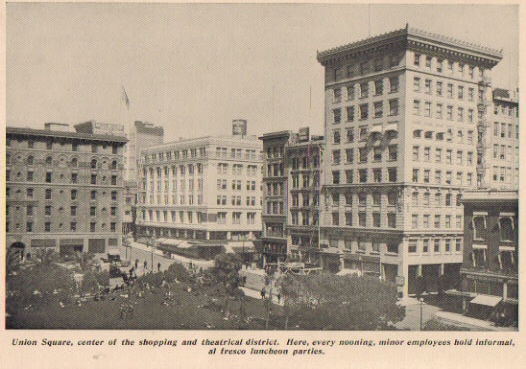 Hard
by is Union Square, a city block of verdure, palm bordered, flower bedded,
path checkered; the gray column of a graceful statue to Admiral Dewey at
its center; faced by the striking facade of the Saint Francis Hotel and
fine commercial buildings. Within two blocks are the Bohemian, Family and
Olympic Clubs, the Columbia, Cort and Orpheum theatres at hand, close to
Tait's and Techau's restaurants. It is the hub of down-town leisure life.
Its benches are always crowded, not with vagrants, but with naught-to-dos,
reading the papers, discussing politics, philosophy and what not. Not of
the wealthy class, these seat-holders; yet not of the tramp community.
Most of them are newly shaven and cleaned, their shoes are patchless, their
trousers unfringed. Bohemians in fraternity, out of work perhaps, but hopeful;
out for air probably, interested in the world in general. On seats reserved
for women are a few similars of the other sex, a maid or two with children.
Others lounge on the sunny turf, for there are no "keep off" signs here,
save one—"Loose Dogs Not Allowed"—a prohibition referring not to habits
but to liberty. No stern policeman orders idlers on. At nooning the lawns
are a pretty sight, with groups of girls and boys at picnic lunch together,
junior clerks and "salesfolk," cash girls and office boys, chumming together,
getting a real midday rest, with health and perhaps a little romance thrown
in. A kindly music-man turns loose from an upper window a flood of phonographic
melody each midday, and aids to make the place unique, delightful.
Hard
by is Union Square, a city block of verdure, palm bordered, flower bedded,
path checkered; the gray column of a graceful statue to Admiral Dewey at
its center; faced by the striking facade of the Saint Francis Hotel and
fine commercial buildings. Within two blocks are the Bohemian, Family and
Olympic Clubs, the Columbia, Cort and Orpheum theatres at hand, close to
Tait's and Techau's restaurants. It is the hub of down-town leisure life.
Its benches are always crowded, not with vagrants, but with naught-to-dos,
reading the papers, discussing politics, philosophy and what not. Not of
the wealthy class, these seat-holders; yet not of the tramp community.
Most of them are newly shaven and cleaned, their shoes are patchless, their
trousers unfringed. Bohemians in fraternity, out of work perhaps, but hopeful;
out for air probably, interested in the world in general. On seats reserved
for women are a few similars of the other sex, a maid or two with children.
Others lounge on the sunny turf, for there are no "keep off" signs here,
save one—"Loose Dogs Not Allowed"—a prohibition referring not to habits
but to liberty. No stern policeman orders idlers on. At nooning the lawns
are a pretty sight, with groups of girls and boys at picnic lunch together,
junior clerks and "salesfolk," cash girls and office boys, chumming together,
getting a real midday rest, with health and perhaps a little romance thrown
in. A kindly music-man turns loose from an upper window a flood of phonographic
melody each midday, and aids to make the place unique, delightful.
It is a parade point also, like Lotta's Fountain. Bands play here on occasions, and reviewing stands are set up. When civic weal demands, speeches are made here, and from here at times firework displays are made. It is a part of distinctive San Francisco.
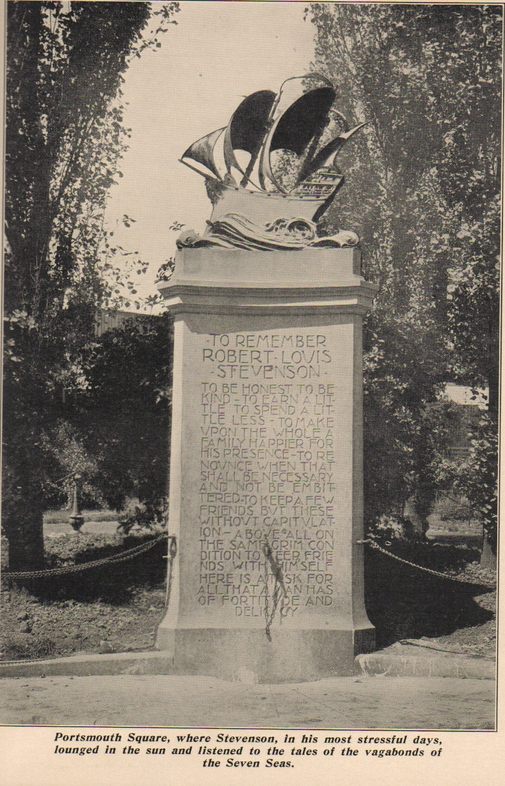 Not
very far away, nearer the bay, between upper Kearny Street and Grant Avenue,
as those streets merge into China City and Latin Town, is Portsmouth Square,
sloping towards the Hall of Justice, a place of history, with its own peculiar
loungers and its own particular monument. Once the custom house was here,
"when the water came up to Montgomery Street," a block away. Now the arbiter
of protective duties has receded harborward with the curbing of the tide.
Commodore Montgomery, of the sloop of war "Portsmouth," raised the American
flag here during the Mexican War; public meetings against lawlessness were
held here by the alcalde in the days of '49; Vigilantes hung their sentenced
criminals on the timbers of neighboring adobes; it has known barricades
and mobs, has been the scene of lawmaking and rioting in the days when
it was the Plaza.
Not
very far away, nearer the bay, between upper Kearny Street and Grant Avenue,
as those streets merge into China City and Latin Town, is Portsmouth Square,
sloping towards the Hall of Justice, a place of history, with its own peculiar
loungers and its own particular monument. Once the custom house was here,
"when the water came up to Montgomery Street," a block away. Now the arbiter
of protective duties has receded harborward with the curbing of the tide.
Commodore Montgomery, of the sloop of war "Portsmouth," raised the American
flag here during the Mexican War; public meetings against lawlessness were
held here by the alcalde in the days of '49; Vigilantes hung their sentenced
criminals on the timbers of neighboring adobes; it has known barricades
and mobs, has been the scene of lawmaking and rioting in the days when
it was the Plaza.
Facing the stately Hall of Justice, on the opposite side of the square, are the back doors of Chinatown, on either side of the dingy alleyways of the ungilded portion of the "tenderloin." A motley crowd invests the square, crosses its pathways, drinks at its fountain.
Shrill-laughing Chinese children, butterfly garbed, play American ball between the shrubberies; wornout hulks of wanderers by many lands and seas sit in the sun, boasting or railing, according to the degrees of their wrecked manhood, and above them a bronze galleon, with surging sails, tops the monument to him who knew and pitied all; humanity, flotsam and jetsam alike—a monument whereon is carved, "To Remember Robert Louis Stevenson," and, following, that sermon of sweet manliness that starts, "To be honest, to be kind—"
Then there is Van Ness Avenue, running at right angles from Market Street—most of the tributaries of the northern bank join that thoroughfare gore fashion—once a stately way of luxurious homes, now coming into a second dignity. Here the great fire halted on the eastern side, and here was set the temporary shopping district during the rehabilitation. West of it lies the better-off class residential district. On it are still some stately homes and some magnificent structures (largely recent) of religious and fraternal significance. Part of it the motor sales industry has pre-empted. At its junction with Market Street the new Civic Center is to be reared, dignified with City Hall, Auditorium, Opera House, Art Gallery, planned to be worthy of the future greatness of the city. The avenue is to be the main thoroughfare tying up the city proper with the Panama-Pacific Exposition in 1915, and it will hold many memories to be of a dignified and pleasant boulevard.
 California
Street, toiling from the Ferry through the wholesale and banking districts,
by Chinatown, up steep grades to Nob Hill, is not for the pedestrian, save
when the summit is reached. Up it clank the cable cars at safe but alarming
grades. Crowning it stands the Fairmont Hotel, copy of an European palace,
flanked by the Pacific-Union and Family clubs and the Art Institute. From
it unrolls a view magnificent. Beneath, to north and east, the commercial
city pitches to the view of gleaming bay, the shipping, the islands and
mountains of the farther shores; to the south and west shines the unsurpassed
panorama of the residential lands. Hills rise here and there, dark with
trees or brightly blocked with houses. All is checkered with light and
shade, dazzling sun against sombre masses, a fog finger stealing in from
the ocean, guided by mysterious currents; gleam of water, the sea breeze
in your face, a gull overhead, below stretching to misty horizons the City
Beautiful.
California
Street, toiling from the Ferry through the wholesale and banking districts,
by Chinatown, up steep grades to Nob Hill, is not for the pedestrian, save
when the summit is reached. Up it clank the cable cars at safe but alarming
grades. Crowning it stands the Fairmont Hotel, copy of an European palace,
flanked by the Pacific-Union and Family clubs and the Art Institute. From
it unrolls a view magnificent. Beneath, to north and east, the commercial
city pitches to the view of gleaming bay, the shipping, the islands and
mountains of the farther shores; to the south and west shines the unsurpassed
panorama of the residential lands. Hills rise here and there, dark with
trees or brightly blocked with houses. All is checkered with light and
shade, dazzling sun against sombre masses, a fog finger stealing in from
the ocean, guided by mysterious currents; gleam of water, the sea breeze
in your face, a gull overhead, below stretching to misty horizons the City
Beautiful.
All about are the houses of the wealthy. Above Nob Hill again rises Russisan Hill, named from the forgotten, lost graves of obscure sailors buried there four score years ago. Here the view is yet more superb to reward the climber, with the vista in all rightfulness pre-empted by lovers and portrayers of the beautiful. About the artist-planned houses are terraced gardens, and though the old-fashioned homes have passed, the place is full of charm and beauty.
