
Care Free San Francisco
By Allan Dunn
Care Free San Francisco
By Allan Dunn
These days, the principal indoor pastimes are those of eating and auction bridge. Unless, indeed, one accepts sleeping as a diversion, and include that. Theater going, concerts, dancing and shopping may also be accounted minor amusements of the same order. It takes more than taste to properly appreciate most of them. However, they are all obtainable in San Francisco. To the visitor the eating and sleeping call for a good hotel. Bridge we have always with us. As to eating, restaurants give variety.
 Let
us consider a California menu. The real bill of fare of a country depends
upon it's specialties and the latter upon its natural larder. In the cosmopolitan
restaurants of the city one can enjoy the piece de resistance of
many countries. You can get bouillabaisse to equal that of Marseilles,
Spaghetti, macaroni, taglierine, ravioli, enchiladas, tamales, frijoles
and stews pungent with herbs, as excellent as those of Naples or Madrid.
The "Charlemagne" of Chinatown with rice perfect in every flake, chicken
and mushrooms tender as rose leaves, young bamboo sprouts vieing with them,
is not lightly to be overlooked. Try the imported escargots, or the frog
legs poulette of Camille or Bianco—call for aught an eipcurean palate of
European fantasy can remember and hotel chef or restauranteur will furnish
it to the correct taste. Your real gourmet, though, your adventurer in
appetite, looks for the indigenous fleshpots, for meats and fruits native
to the soil, and out of this great larder of California, with its bi-climatic
outputs of temperate and tropic zone, there will be found many a new bonne
bouche. The world eats canned what the Californian eats au naturel.
The grapefruit, the orange, the apple, pear, peach, apricot, fig and grape,
all the delicious, acidulous range of fruit comes to you from the tree.
If you order strawberries in December they have not been forced, but picked
outdoors within the half day. Somewhere in the State they ripen every month.
If you feel like raspberry shortcake in October you shall call for it and
not be disappointed. Celery and asparagus, artichokes of luscious heart,
all the edible vegetable kingdom fill the markets.
Let
us consider a California menu. The real bill of fare of a country depends
upon it's specialties and the latter upon its natural larder. In the cosmopolitan
restaurants of the city one can enjoy the piece de resistance of
many countries. You can get bouillabaisse to equal that of Marseilles,
Spaghetti, macaroni, taglierine, ravioli, enchiladas, tamales, frijoles
and stews pungent with herbs, as excellent as those of Naples or Madrid.
The "Charlemagne" of Chinatown with rice perfect in every flake, chicken
and mushrooms tender as rose leaves, young bamboo sprouts vieing with them,
is not lightly to be overlooked. Try the imported escargots, or the frog
legs poulette of Camille or Bianco—call for aught an eipcurean palate of
European fantasy can remember and hotel chef or restauranteur will furnish
it to the correct taste. Your real gourmet, though, your adventurer in
appetite, looks for the indigenous fleshpots, for meats and fruits native
to the soil, and out of this great larder of California, with its bi-climatic
outputs of temperate and tropic zone, there will be found many a new bonne
bouche. The world eats canned what the Californian eats au naturel.
The grapefruit, the orange, the apple, pear, peach, apricot, fig and grape,
all the delicious, acidulous range of fruit comes to you from the tree.
If you order strawberries in December they have not been forced, but picked
outdoors within the half day. Somewhere in the State they ripen every month.
If you feel like raspberry shortcake in October you shall call for it and
not be disappointed. Celery and asparagus, artichokes of luscious heart,
all the edible vegetable kingdom fill the markets.
 Does
your appetite fail? Ask not for tonic or doctor, but stroll through the
California market. Here at first hand is spoil for Lucullus. Pineapples
and alligator pears fresh from Hawaii. Papaias, too, and bananas. Mexico
sends her best on a twenty-four schedule. The wizard of fruitdom, Burbank,
perfects his marvels only two hours' distance from the Ferry, and you may
call for his pitless plums, potatoes of concentrated flour, and magic berries
with blends of sweetly puckering juice. His latest masterpiece, a glorified
prickly pear, eats like a combination of the heart of a watermelon and
a Bartlett pear.
Does
your appetite fail? Ask not for tonic or doctor, but stroll through the
California market. Here at first hand is spoil for Lucullus. Pineapples
and alligator pears fresh from Hawaii. Papaias, too, and bananas. Mexico
sends her best on a twenty-four schedule. The wizard of fruitdom, Burbank,
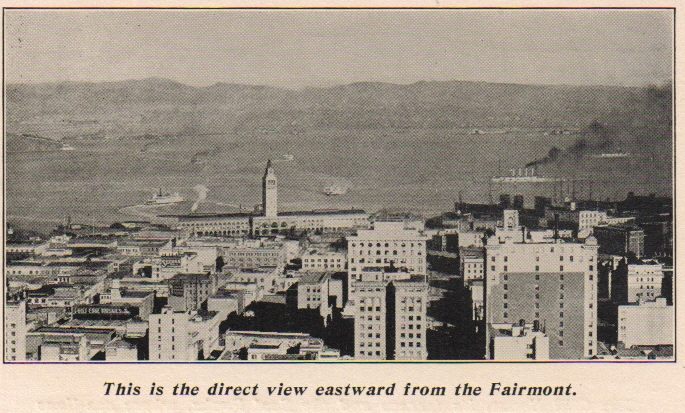
perfects his marvels only two hours' distance from the Ferry, and you may
call for his pitless plums, potatoes of concentrated flour, and magic berries
with blends of sweetly puckering juice. His latest masterpiece, a glorified
prickly pear, eats like a combination of the heart of a watermelon and
a Bartlett pear.
Delicate sea foods, fresh landed at Fisherman's Wharf await you. Their evanescent flavors are unspoiled by ice-packed travel. Pompano, sand dabs, sole, firm encarnadined shoulder cutlets of salmon that in six hours exchange the chasing of sardines outside the Golden Gate for the will of your fork tines; sea trout, brook trout, lake trout, striped bass, white sea bass, tomcod, all fresh as whitebait at Richmond, and more genuine. Transplanted Eastern oysters which flourish but breed not, and so have not "R" months of banishment. The little California oyster—essence of succulence—the California lobster, clawless but worthy of the skill of a Chateaubriand.
 Wish
you game—hare hunter style? Venison or mayhap duck? Of the latter take
your choice of mallard, teal, canvasback or sprig, yet if you would be
wise choose the latter. As this chronicle is not a Baedeker, neither is
it a Mr. Rohrer, therefore let it suffice that, to the sapient, Californian
eating , in the preparation and the realization, has long been provided
for its excellence. At the Saint Francis and the Palace the chefs have
fame that commands recognition in the capitals of Europe. Yours to command,
they will prove faithful genii. At bergez-Frank's, the Poodle Dog, Blanco's,
the Maison Doree, at Coppa's, Frank's, and Felix, at Dante's, at Techau'
or at Tait's you will find digestion wait on appetite, pick from the concentration
of French, Italian, Spanish, German, Austrian and America culinary triumphs
and find music and singing and Bohemian unrestraint—even to cabinets
particuliers. Tait's, indeed, the uptown favorite of pre- and post-theater
patrons, emulates in carte du jour, decoration and a variety of
vaudeville, the accepted restaurants of all big cities.
Wish
you game—hare hunter style? Venison or mayhap duck? Of the latter take
your choice of mallard, teal, canvasback or sprig, yet if you would be
wise choose the latter. As this chronicle is not a Baedeker, neither is
it a Mr. Rohrer, therefore let it suffice that, to the sapient, Californian
eating , in the preparation and the realization, has long been provided
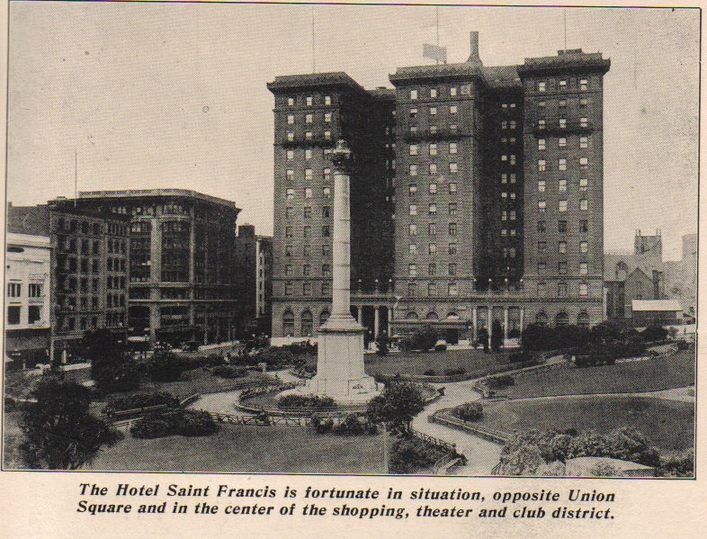
for its excellence. At the Saint Francis and the Palace the chefs have
fame that commands recognition in the capitals of Europe. Yours to command,
they will prove faithful genii. At bergez-Frank's, the Poodle Dog, Blanco's,
the Maison Doree, at Coppa's, Frank's, and Felix, at Dante's, at Techau'
or at Tait's you will find digestion wait on appetite, pick from the concentration
of French, Italian, Spanish, German, Austrian and America culinary triumphs
and find music and singing and Bohemian unrestraint—even to cabinets
particuliers. Tait's, indeed, the uptown favorite of pre- and post-theater
patrons, emulates in carte du jour, decoration and a variety of
vaudeville, the accepted restaurants of all big cities.
Before we leave our restaurant, a word on drinking. California wines are cursed with a propensity for mimic nomenclature. As "types" of all well-known brands are they labeled, prompted by imported vine-cuttings and close similarity of soil and climate. Some day the wine-growers will, like those of the Rhine and Switzerland, boldly give them independent names, and they will come into their own. Vintages are beginning to be recognized and blends are diminishing. Ask some Californian friend who knows how to dine to introduce you to a bottle of native wine, white or red. Forget its label and you will not regret the venture.
 Time
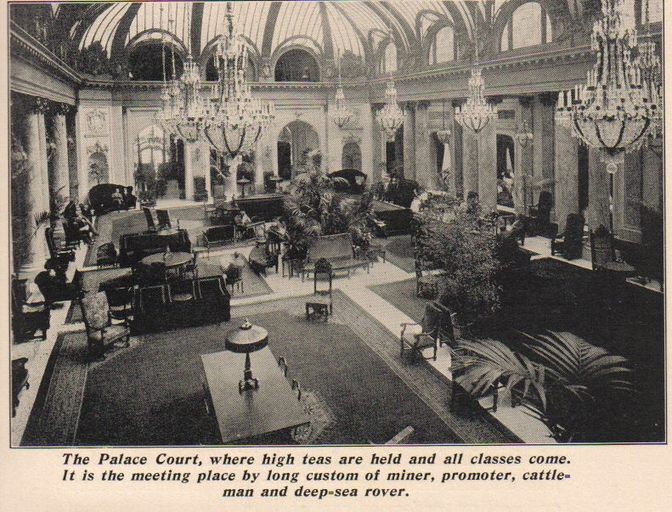
was when the Palace was one great hotel of the city. Kings, chancellors,
ambassadors, diplomats of white and yellow, brown and duskier races have
wined and dined and slept there—and still do. It holds yet the atmosphere
of the early days, and in its palm-shaped court the modern representatives
of adventure, miner, gambler, cattleman and sea rover yet feel at home
and are unawed by the four hundred at their tea. Social events are divided,
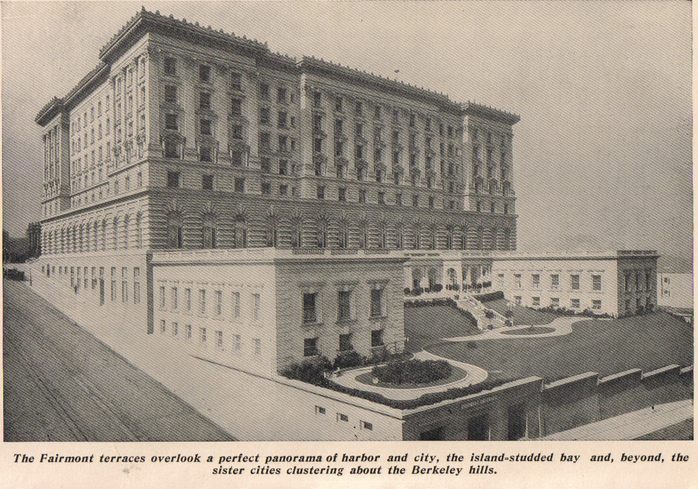
like other honors, with the Palace by the Fairmont, on the hill, and the
Saint Francis on Union Square. The Palace held the great Mardi Gras ball
of 1912, the Fairmont is the scene of the Greenway cotillions, while the
chamber concerts go to the Saint Francis.
Time
was when the Palace was one great hotel of the city. Kings, chancellors,
ambassadors, diplomats of white and yellow, brown and duskier races have
wined and dined and slept there—and still do. It holds yet the atmosphere
of the early days, and in its palm-shaped court the modern representatives
of adventure, miner, gambler, cattleman and sea rover yet feel at home
and are unawed by the four hundred at their tea. Social events are divided,
like other honors, with the Palace by the Fairmont, on the hill, and the
Saint Francis on Union Square. The Palace held the great Mardi Gras ball
of 1912, the Fairmont is the scene of the Greenway cotillions, while the
chamber concerts go to the Saint Francis.
As to social amusements—for the inner circle one carries one's own entree.The city is renowned for its hospitality. Are you of the of gay world elsewhere, your cachet is acknowledged instanter and private homes and the clubs of city and country open to you. For entertainment open to all, there is much. The chief theatrical attractions always are booked and, thanks to its claimate, in the summer San Francisco offers unequaled playbills.
Music is pre-eminently recognized. The Symphony Concert, two seasons, under Henry Hadley's baton, satisfied the fastidious. Every artiste recognizes a San Francisco audience as more than whimsically worth while.
There are the usual coterie of clubs, social, commercial, official and national. The most original is the Bohemian Club, a coterie of wits, professional men of the Arts and Sciences, and their recognized admirers. The athletes have a magnificent organization in the Olympic Club. The Country clubs are not supposedly of "indoor" interest. Let us pass them by, closing the chapter with a hint to visit the Mission, the Mint and the museums at the Affiliated Colleges (particularly full of anthropological interest) and at Golden Gate Park.
